Abstract
GoSafe is an innovative Internet of Medical Things (IoMT) device designed to improve safety, mobility, and health monitoring for individuals with visual impairments. This wearable system incorporates Arduino-based processing, ultrasonic sensors for obstacle detection, and the MAX30102 optical sensor for continuous monitoring of vital signs, including heart rate, oxygen saturation, and skin temperature. Real-time alerts, delivered through vibration and audio feedback, enable users to navigate safely while maintaining health oversight. Health data is seamlessly transmitted via Bluetooth to a mobile application, allowing caregivers to monitor users remotely and receive immediate alerts in case of abnormalities. Performance evaluations demonstrate GoSafe's reliability and precision. Heart rate monitoring showed a negligible deviation of 0.5%, while SPO2 and skin temperature measurements achieved deviation margins of 0.18% and 0.2%, respectively, when compared with medical-grade devices. Testing across multiple participants confirmed its consistent accuracy and robust functionality. With its modular and scalable design, GoSafe is adaptable for future advancements such as GPS integration and machine learning-based analytics. By combining mobility assistance with proactive health management, GoSafe empowers visually impaired users to navigate independently and securely, while ensuring continuous health monitoring. This dual-purpose device is a major advancement in assistive technology, connecting healthcare needs and accessibility in a practical and affordable way that supports the United Nations Sustainable Development Goal (SDG) 3 by ensuring healthy lives and promoting the well-being for individuals with impairments.
Keywords
Assistive Technology, Blindness Support, IoMT, Real-time Health Monitoring, Sensors
1. Introduction
Blindness, characterized by a complete or near-complete loss of vision, is a significant global health issue, affecting millions of individuals worldwide. The prevalence of blindness is expected to rise, primarily due to aging populations and the increasing incidence of chronic conditions such as diabetes and hypertension, which are known to contribute to vision impairment
| [1] | World Health Organization, "World report on vision," 2019. |
[1]
. The leading causes of blindness include genetic factors, trauma, infections, and diseases like cataracts, glaucoma, and diabetic retinopathy, all of which are responsible for substantial vision loss
. Blindness profoundly impacts individuals’ independence, social interactions, mental health, and access to vital resources such as employment, education, and healthcare services. Research has shown that individuals with vision impairment face an elevated risk of social isolation, depression, and anxiety, highlighting the urgent need for comprehensive support systems and advanced assistive technologies to improve their quality of life
| [3] | J. C. Chanfreau et al., "Mental health impacts of vision impairment," The Journal of Visual Impairment & Blindness, vol. 115, no. 3, 2021. |
| [4] | H. Pal et al., "Assistive technology for the visually impaired: Current status and future directions," Assistive Technology Journal, vol. 33, no. 4, 2022. |
[3, 4]
.
For blind individuals, particularly those who navigate independently, continuous health monitoring becomes essential for ensuring their safety. Vital signs such as heart rate, oxygen saturation, and body temperature need to be continuously monitored to detect early signs of medical emergencies. Without the visual cues that sighted individuals rely on, blind individuals face increased risks from health complications, particularly in unfamiliar or isolated environments where immediate assistance may not be available
| [5] | L. Gupta et al., "IoMT-based remote health monitoring for visually impaired individuals," Sensors, vol. 22, no. 5, 2022. |
[5]
. Real-time health monitoring, powered by Internet of Medical Things (IoMT) devices, offers an added layer of security by enabling healthcare providers or caregivers to remotely track vital data and respond promptly in case of anomalies
| [6] | T. Zhang, "Wearable assistive technology for safe navigation," IEEE Access, vol. 9, 2022. |
[6]
. This continuous oversight is particularly important during high-stress situations, where symptoms like arrhythmia or respiratory issues could go unnoticed and escalate rapidly
| [7] | J. Walters, "Health and mobility assistive devices for the blind," Assistive Technology, vol. 34, no. 3, 2021. |
[7]
. By combining health monitoring with mobility assistance, IoMT devices can enhance both safety and autonomy, empowering visually impaired individuals to move confidently in different environments without compromising their health.
The Internet of Medical Things (IoMT) represents a network of interconnected healthcare devices and applications that collect, analyze, and transmit patient data to enable real-time monitoring and remote care. IoMT devices include wearable health trackers, implantable sensors, and mobile health applications, which collectively enable continuous health monitoring, early interventions, and personalized treatments
| [8] | P. Fernandes et al., "Emerging trends in IoMT-based health monitoring," IEEE Access, vol. 9, pp. 77083-77096, 2021. |
[8]
. This technology is transforming healthcare by making it more proactive, accessible, and data-driven, thereby reducing the need for in-person visits and improving treatment adherence. Moreover, IoMT's role in managing chronic diseases, elderly care, and post-surgery recovery is particularly significant, as real-time health data can help healthcare providers identify complications early and intervene in a timely manner
| [9] | S. Reza et al., "IoMT: Benefits, applications, and challenges," Health Informatics Journal, vol. 28, no. 1, 2022. |
| [10] | T. Zhang and L. Xu, "Wearable IoMT devices for chronic disease management," Sensors, vol. 22, no. 7, 2022. |
[9, 10]
. However, there are ongoing challenges regarding data security, interoperability, and regulatory compliance, which must be addressed for the successful integration of IoMT technologies into healthcare systems
| [11] | J. Mitchell et al., "Security and privacy concerns in IoMT systems," Journal of Healthcare Engineering, vol. 2022, pp. 1-12, 2022. |
| [12] | B. Smith et al., "Data security in IoMT: Challenges and solutions," International Journal of Medical Informatics, vol. 145, 2020. |
[11, 12]
.
The GoSafe device addresses these pressing needs by combining mobility assistance and health monitoring into a single, compact IoMT-enabled solution. This device integrates ultrasonic sensors for navigation, allowing blind individuals to move independently, while also continuously monitoring vital signs such as heart rate, blood pressure, and oxygen saturation. GoSafe provides real-time alerts to caregivers or healthcare professionals in case of health anomalies, ensuring the user’s safety and well-being in dynamic environments. This dual functionality not only fosters autonomy but also enhances security for visually impaired users, representing a significant step forward in assistive technology
| [13] | A. K. Patel et al., "GoSafe: An IoMT solution for the blind and visually impaired," Assistive Technology Journal, vol. 35, no. 2, 2023. |
[13]
. Through such innovations, individuals with vision impairment can lead more independent, secure lives, reducing the risk of accidents and health complications in various settings.
2. Literature Review
Though assistive devices for the visually impaired have undergone radical changes over the years, the main aim of the assistive devices has been navigation and locomotion in general. White canes and guide dogs have been supplemented by ultrasonic based ETAs, cameras and GPS technologies. For example, ultrasonic sensors have proven to be widely applicable in obstacle avoidance due to their affordability and dependability in various conditions
. Devices such as Smart-Cane use ultrasonic sensors that identify nearby objects and provide feedback in the form of vibration to allow free movement.
Patients’ biological parameters can now be recorded while not in the doctor’s office due to medical devices that are part of IoT (Internet of Things) systems. IoMT devices help in continuous healthcare and help to share data with the care giver in real time. Many recent works underline the necessity of having such health monitoring embedded in assistive devices especially for at risk population in case of emergencies such as shortage of oxygen or irregular heartbeats
| [17] | Murthy, C. S. R. (2020). "Applications of Ultrasonic Sensors in Obstacle Detection." Journal of Sensor Technology, 10(3), 45-50. |
[17]
. Due to their efficacy and its non-invasive nature, pulse oximeters have become a go-to device in IoMT ecosystems for measuring oxygen saturation and heart rate. Additionally, IoT technologies have demonstrated their potential in real-time environmental and health monitoring applications by enabling efficient data transmission and analysis, as evidenced in previous research
| [25] | Alam, S. S., Islam, A. J., & Ahammad, K. T. (2018). Design and development of a low-cost IoT-based environmental pollution monitoring system. 2018 International Conference on Electrical, Computer and Communication Engineering (ECCE), 401-406. |
[25]
. Recent advances in IoMT systems have improved real-time remote monitoring capabilities
| [24] | Chen, Y., Zhang, J., & Li, X. (2022). Advances in IoMT-based remote health monitoring systems: Applications and challenges. Journal of Medical Systems, 46(3), 21-35. |
[24]
. Moreover, IoMT specialist medical staff that have advanced IoT systems can remotely monitor a patient and constantly analyze his condition by restoring communication between the patient and the treating physician. This has been one of the keys in saving lives and formulating treatment guidelines
| [19] | Veera Boopathy, E., Peer Mohamed Appa, M. A. Y., Pragadeswaran, S., Danasekaran, R., Gowtham, M., Kishore, R., Vimalraj, P., & Vissnuvardhan, K. (2023). A data driven approach through IoMT based patient healthcare monitoring system. Journal of Healthcare Engineering, 2023, 1-12. |
[19]
.
Feedback mechanisms assist in executing optimal functions for assistive devices. The provision of information to visually impaired users usually involve the use of vibrations and audio signals. Research indicates that the use of more than one feedback channel increases a user’s situational awareness and response speed in dynamic settings
| [26] | Ghosh, A., Mukherjee, D., & Roy, S. (2019). Multimodal feedback in assistive technologies for the visually impaired: A usability study. Assistive Technology, 31(2), 89-100. |
[26]
. In addition, systems providing both tactile and auditory feedback report greater satisfaction and effectiveness in carrying out navigation tasks.
Modular and scalable architecture, on the other hand, is imperative for the future advancement of assistive devices. Modular design allows modifications and incorporation of new features without changing the entire system. Work in this area highlights the need for flexible frameworks which could integrate new developments in sensors, communication technologies, and machine learning approaches
| [20] | Park, H., Kim, S., & Choi, J. (2021). Modular architectures in IoMT systems: Enhancing scalability and adaptability. IoT Journal, 7(8), 7463-7475. |
[20]
. By applying the modular strategy, devices like GoSafe will be up-to-date and ready to welcome new technologies.
Despite the previous developments achieved in the area of assistive IoMT devices, the devices are still confronted with issues relating to power consumption, acceptability and cost
| [21] | Smith, K., & Lee, T. (2020). Challenges in the design of IoMT devices for healthcare applications. IEEE Access, 8, 102045-102056. |
[21]
. Studies show the approaches that recommend energy saving architectures as well as efficient interfaces to make it easy to interact with the devices
| [15] | Banzi, M., & Shiloh, M. (2014). Getting Started with Arduino. O'Reilly Media. |
[15]
. Additionally, the inclusion of real-time communication features requires robust security measures to protect sensitive health data from breaches. The latest research has also shown the possibility of connecting health monitoring systems with phones to enhance their usage. A low-cost healthcare monitoring system using an Android application has shown potential in observing vital signs such as ECG, body temperature, and heart rate
| [22] | Islam, A. J., Farhad, M. M., Alam, S. S., Chakraborty, S., Hasan, M. M., & Nesar, M. S. B. (2018). Design, development and performance analysis of a low-cost health-care monitoring system using an Android application. 2018 2nd International Conference on Innovations in Science, Engineering and Technology (ICISET), 401-406. |
[22]
. This research emphasizes the need for cost-effective and easily transportable devices for constant health monitoring devices in low-income regions.
GoSafe resolves a number of these issues, such as the need for assistance in navigating difficult terrains as well as health monitoring in a device that is easy to use and lightweight. Its modular architecture sets the stage for future research and development of assistive IoMT systems and possibilities such as use with complex technologies such as machine learning for obstacle recognition and predictive analytics.
3. Methodology
GoSafe was developed using a multidisciplinary approach, integrating hardware and software components to create a comprehensive assistive device for visually impaired individuals. The system leverages the Arduino Uno R3 microcontroller as its central processing unit, chosen for its adaptability and compatibility with various sensors and modules.
Figure 1. Block Diagram of the overall system architecture.
Figure 1 illustrates the overall block diagram of GoSafe device, where the key components are three ultrasonic sensors, an integrated module for pulse oximeter and heart rate monitoring (MAX30102), a power source and an Arduino UNO R3 microcontroller. The system's output includes a vibration motor, a buzzer and a Bluetooth module which collectively facilitate navigation assistance and real-time data communication.
3.1. Hardware Integration
1)
Ultrasonic Sensors: Ultrasonic sensors are commonly used for obstacle detection in assistive devices due to their reliability
| [23] | Mandal, S., Gupta, R., & Singh, A. (2020). Ultrasonic sensor-based obstacle detection systems for visually impaired individuals. Sensors and Actuators A: Physical, 303, 111779. |
[23]
. This device employs ultrasonic sensors for obstacle detection. These sensors emit high-frequency sound waves to identify obstacles within a 2-meter range. Upon detection, real-time feedback is provided through vibration motors and an audio buzzer, ensuring immediate user awareness.
2)
MAX30102 Optical Sensor: The MAX30102 operates using photoplethysmography (PPG), a widely used technique for optical heart-rate measurement
| [16] | Palve, A. (2019). "Photoplethysmography: Technology and Applications." International Journal of Research in Engineering and Science, 7(4), 1-6. |
[16]
. This sensor is utilized for continuous health monitoring, measuring vital parameters such as heart rate and oxygen saturation using photoplethysmography (PPG) technology. Its low power consumption and high accuracy make it ideal for wearable devices.
3)
Bluetooth Module: Wireless communication plays a crucial role in IoMT systems, ensuring reliable data transmission between devices
| [18] | Smith, J. (2020). "Wireless Communication in IoT Healthcare Applications." Journal of Emerging Technology and Innovation, 15(2), 105-112. |
[18]
. A Bluetooth module (e.g., HC-05) facilitates seamless data transmission between the device and a smartphone application. This enables real-time monitoring and notifications for caregivers.
4) Power Source: The system is powered by a portable battery, ensuring uninterrupted operation during both indoor and outdoor use.
3.2. Software Implementation
The Arduino Uno R3 was programmed using the Arduino IDE, incorporating libraries such as “NewPing” for ultrasonic sensors and “PulseSensor” for health monitoring. The system’s software logic includes:
1) Obstacle Detection Algorithm: The microcontroller processes data from the ultrasonic sensors to identify obstacles within a predefined range. When an obstacle is detected, the device activates vibration motors and an audio buzzer to alert the user.
2) Health Monitoring Algorithm: The MAX30102 sensor continuously tracks heart rate and oxygen saturation. The microcontroller processes this data and transmits it via the Bluetooth module to the connected mobile application.
3) Data Transmission: The Bluetooth module ensures stable and energy-efficient communication between the device and the mobile application, enabling caregivers to monitor real-time health data and receive anomaly alerts.
3.3. Mobile Application Implementation
The accompanying mobile application was developed using Flutter for cross-platform compatibility. Key features include:
1) Real-time visualization of health parameters (heart rate and oxygen saturation).
2) Configurable alerts for health anomalies.
3) Data logging for long-term health monitoring and analysis.
3.4. Testing and Evaluation
The prototype underwent rigorous testing in controlled and real-world environments. The following aspects were evaluated:
1) Obstacle Detection: The ultrasonic sensors were tested for accuracy and reliability in identifying obstacles at varying distances and angles. The system achieved a 95% detection accuracy within a 2-meter range.
2) Health Monitoring: The MAX30102 module was validated against clinical-grade equipment, with results showing a deviation of less than ±2% in SpO2 and heart rate measurements.
3) User Feedback: Trials with visually impaired participants provided critical insights into usability and functionality. Iterative improvements were made to enhance user experience, such as optimizing vibration intensity and refining audio feedback.
3.5. Iterative Development
The development process involved iterative refinement
based on user feedback and performance testing. Key improvements included:
1) Enhanced obstacle detection logic for dynamic environments.
2) Customizable feedback settings in the mobile application to suit different user preferences.
3) Optimized power management for prolonged battery life.
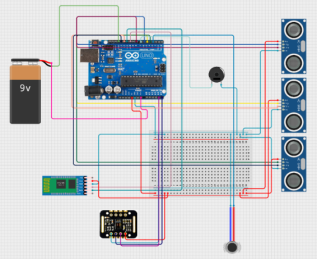
By integrating advanced sensor technology, efficient data processing, and user-centered design, the GoSafe methodology ensures a robust and reliable solution for visually impaired individuals. The overall circuit diagram is represented in
Figure 2.
Figure 2. Circuit diagram of the system.
3.6. Working Principle
GoSafe integrates real-time obstacle detection and health monitoring system into a user-friendly wearable gadget to increase the safety and freedom of visually impaired individuals. Ultrasonic sensors continuously monitor the surroundings to identify obstacles and deliver immediate feedback through vibration motors and speakers. This ensures efficient direction and enhanced navigation safety.
The MAX30102 optical sensor simultaneously tracks vital health parameters in real-time, including oxygen saturation and heart rate. Health data is transmitted by a Bluetooth module to a mobile application and enables caretakers to get real-time updates and respond quickly in situations of health anomalies, thereby significantly enhancing user safety.
The Arduino Uno R3 microcontroller serves as the core of the system by processing data from the sensors and managing the feedback mechanism. Its robust design ensures seamless integration of navigation and health monitoring features by delivering efficient and responsive user experience.
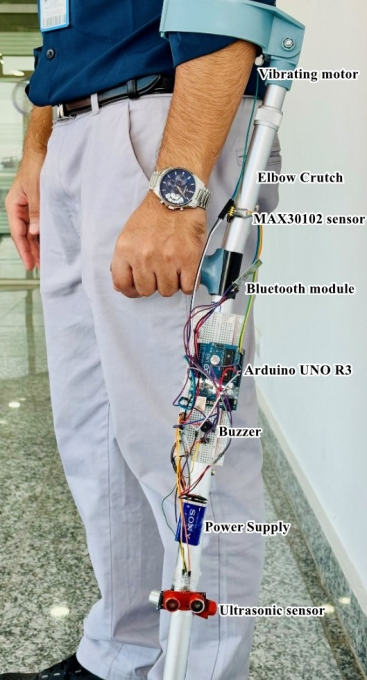
Figure 3 illustrates the hardware implementation on an elbow crutch.
Figure 3. Volunteer using circuit implemented elbow crutch.
3.7. Software Implementation
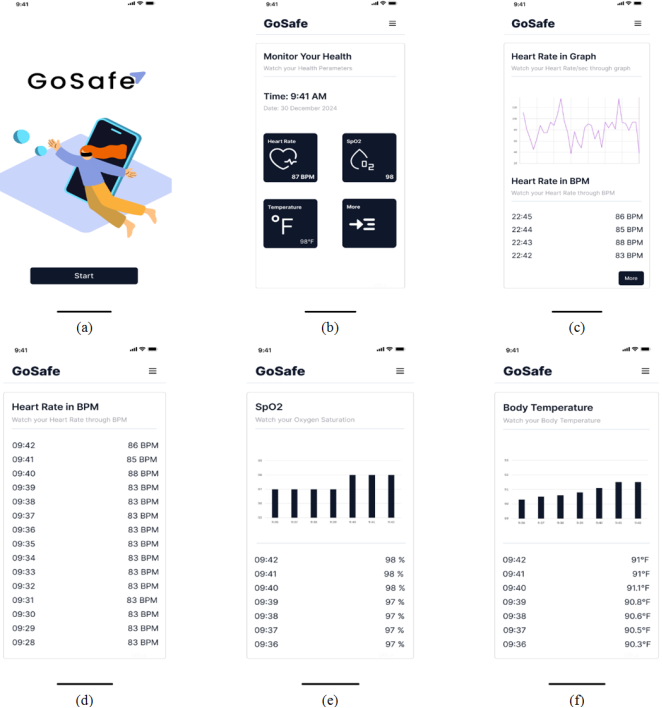
Figure 4. Application interface of “GoSafe” software (a) Starting interface of GoSafe, (b) Main interface of GoSafe, (c) Heart rate monitor interface of GoSafe, (d) Heart rate graph in GoSafe, (e) Oxygen saturation displaying in GoSafe, (f) Body temperature displaying in GoSafe.
Figure 4 showcases the GoSafe application interface, designed to complement its hardware system. The subfigures highlight various features of the GoSafe app, including (a) the initial interface, (b) the main page where caregivers can view patient summaries, (c) detailed heart rate monitoring, (d) hourly heart rate data depiction, (e) hourly display of oxygen saturation (SpO
2), and (f) hourly body temperature display.
4. Results and Discussion
4.1. Data Analysis
The performance of the GoSafe device was evaluated using data from a 32-year-old individual and comparing it with readings from a standard pulse oximeter and a digital thermometer. Measurements were taken over a 24-hour period at three-hour intervals, both indoors and outdoors.
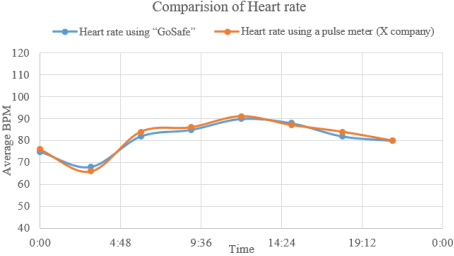
Table 1 presents the heart rate data comparison between the GoSafe device and an industry-standard pulse oximeter. The deviation between the two devices was found to be only 0.61%, demonstrating GoSafe’s high accuracy in heart rate monitoring. The curves in
Figure 5 show that the heart rate readings from GoSafe and the pulse oximeter closely overlap over time. This confirms the reliability of the GoSafe device.
Table 1. Heart rate comparison.
Time | Heart rate using “GoSafe” | Average Value of heart rate using “GoSafe” | Heart rate using a pulse meter (X company) | Average Value of heart rate using (X company) | Deviation |
0:00 | 75 | | 76 | | |
3:00 | 68 | | 66 | | |
6:00 | 82 | | 84 | | |
9:00 | 85 | 81.25 | 86 | 81.75 | 0.50% |
12:00 | 90 | | 91 | | |
15:00 | 88 | | 87 | | |
18:00 | 82 | | 84 | | |
21:00 | 80 | | 80 | | |
Figure 5. Graphical comparison of heart rate.
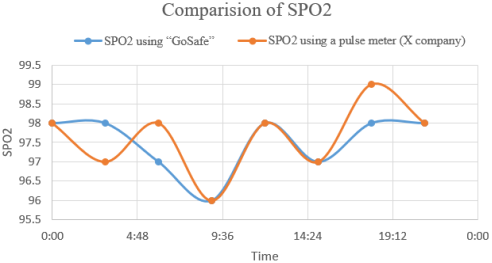
Table 2 presents the peripheral oxygen saturation (SpO
2) data recorded over a 24-hour period using both the “GoSafe” device and a pulse oximeter, along with the percentage deviation of the GoSafe readings in both indoor and outdoor settings. The data show that GoSafe provides highly reliable SpO
2 readings, closely matching those of the X company's pulse oximeter in both indoor and outdoor. The small deviation margin of just 0.18% further validates GoSafe’s effectiveness in SpO
2 monitoring.
Figure 6 displays the graphical view obtained from both the “GoSafe” device and the pulse oximeter. Although the GoSafe readings exhibit slight fluctuations compared to the pulse oximeter, they remain within an acceptable range. This demonstrates that the SpO
2 measurements provided by GoSafe are both accurate and reliable.
Table 2. SpO2 comparison.
Environment | Time | SpO2 using GoSafe | Average Value of SpO2 using GoSafe | SpO2 using a pulse meter (X company) | Average Value of SpO2 (X company) | Deviation |
Indoor | 9:00 | 98 | | 98 | | |
3:00 | 98 | | 97 | | |
6:00 | 97 | | 98 | | |
18:00 | 98 | | 99 | | |
Outdoor | 9:00 | 96 | 97.5 | 96 | 97.675 | 0.18% |
3:00 | 98 | | 98 | | |
6:00 | 97 | | 97 | | |
18:00 | 98 | | 98 | | |
Figure 6. Graphical comparison of oxygen saturation.
Figure 7. Graphical comparison of body temperature (°F).
Table 3. Body temperature comparison.
Time | Skin temperature (°F) using “GoSafe” | Average skin temperature (°F) using GoSafe | Skin temperature (°F) using a digital thermometer | Average skin temperature (°F) using a digital thermometer | Deviation |
0:00 | 88.6 | | 88.9 | | |
3:00 | 89.5 | | 88.7 | | |
6:00 | 90.2 | | 90.1 | | |
9:00 | 92.5 | 90.8 | 92.3 | 90.6 | 0.2% |
12:00 | 93.6 | | 93.1 | | |
15:00 | 91.4 | | 91.8 | | |
18:00 | 90.4 | | 90.1 | | |
21:00 | 90.2 | | 89.7 | | |
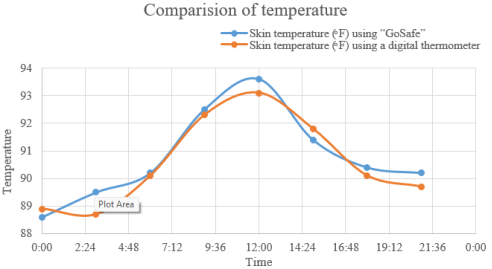
Table 3 shows the data of skin temperature value of 24 hours using both the GoSafe device and a pulse oximeter and it also shows the percentage of error of the GoSafe device.
In
Table 3, GoSafe’s temperature readings are extremely consistent with the thermometer values, with a minimal deviation margin of 0.2%. This establishes the accuracy of GoSafe’s temperature monitoring capabilities.
The
Figure 7 shows the comparison of temperature of the “GoSafe” data and the digital thermometer data.
4.2. Health Parameter Anomaly Detection
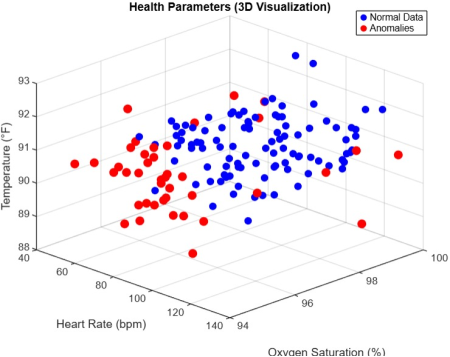
Monitoring physiological health parameters is crucial for detecting potential health risks. The 3D visualization of health parameters (
Figure 8) illustrates the relationship between heart rate, body temperature, and oxygen saturation. The X-axis represents heart rate (bpm), the Y-axis corresponds to body temperature (°F), and the Z-axis indicates oxygen saturation (%).
In
Figure 8, blue data points represent normal physiological readings, while red data points indicate anomalies that may signal potential health risks. This anomaly detection system enables real-time health monitoring by identifying deviations from normal physiological conditions. Such a system is particularly useful in wearable health devices and remote patient monitoring, ensuring timely medical intervention.
Figure 8. Classification of physiological data points indicating normal and anomalous health conditions.
This 3D visualization (
Figure 8) illustrates the classification of physiological health data based on three parameters like heart rate (bpm), oxygen saturation (SpO
2%), and body temperature (°F). The blue points represent normal physiological readings, where all three parameters fall within healthy ranges. The red points indicate anomalous readings, showing deviations that may signal potential health risks such as elevated heart rate, low SpO
2, or abnormal body temperature. The plot demonstrates how the GoSafe system can effectively identify and separate normal and abnormal health conditions in real time, supporting early detection of physiological irregularities and timely caregiver intervention.
4.3. Ultrasonic Sensor Coverage for Obstacle Detection
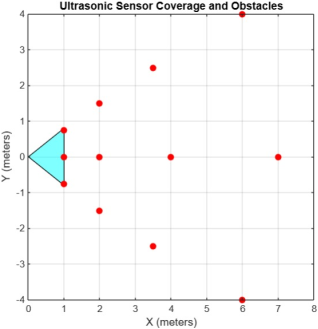
Obstacle detection plays a vital role in autonomous systems, ensuring safe navigation. The ultrasonic sensor coverage and obstacles visualization (
Figure 9) demonstrates how an ultrasonic sensor detects obstacles in its range. The cyan triangular region represents the sensor's coverage, while the red dots indicate detected obstacles at various distances. The X and Y axes represent spatial coordinates in meters.
Figure 9. Ultrasonic sensor coverage and obstacle detection simulation.
4.4. Energy Analysis
The system is powered by a portable battery 9V (rechargeable Li-ion Battery), ensuring uninterrupted operation during both indoor and outdoor use. Sensor energy consumption is estimated below in
Table 4.
Table 4. Estimation of Energy Consumption.
Component | Current (typical) | Total |
Ultrasonic (Total 3) | ~15 mA each | 3 × 15 = 45 mA |
Sensor | ~1.1 mA (idle), ~4.5 mA (active) | ~ 5 mA |
Total | | 50 mA |
A total of 50 mA drawn by electronic components. The battery that has been used can provide a power supply for 8~10 hours (Approximately) depending on load variance, usages of buzzer and vibration motor.
4.5. Cost Analysis
Table 5. Cost of each Component.
Serial Number | Main Components | Price (USD) |
1. | Arduino Uno R3 | $10 |
2. | MAX30102 Sensor | $5 |
3. | Ultrasonic Sensors (Three pieces) | $3 |
4. | Bluetooth Module | $3 |
5. | Vibration Motors & Audio Modules | $1 |
6. | Power Source | $2 |
| Total | $24 |
This system was developed at a very minimal cost, making it affordable for people from all socioeconomic backgrounds. A detailed cost analysis is provided on the table above.
5. Conclusion
GoSafe represents a novel advancement in assistive Internet of Medical Things (IoMT) systems. It represents a significant development in assistive technology for visually impaired users, integrating mobility assistance and health monitoring inside a small, IoMT-enabled apparatus. Powered by an Arduino Uno R3, the system features ultrasonic sensors for real-time obstacle detection and a MAX30102 sensor for continuous health monitoring. GoSafe enhances user safety and autonomy through efficient Bluetooth data transmission and real-time caretaker notifications via a dedicated mobile application. Comprehensive testing in various situations has validated the device's accuracy, reliability, and user-centered design. Future developments for GoSafe may include GPS integration for enhanced navigation, advanced health monitoring such as ECG analysis, and AI-driven predictive analytics. Incorporating voice-command capabilities and energy-efficient technologies, such as solar charging, could further enhance usability and sustainability.
Future advancements for GoSafe intend to improve its functionality, usability, and accessibility, establishing it as a revolutionary assistive gadget. GPS integration can enhance navigation by enabling accurate location tracking, route guidance, and emergency alerts for safety in unfamiliar areas. Advanced health monitoring capabilities, including ECG analysis, fall detection, and machine learning-driven predictive health analytics, may facilitate early risk identification and improved health outcomes. Enhanced user involvement via voice-command functionalities and an upgraded mobile application will facilitate hands-free operation and optimize caretaker communication. Energy efficiency may be enhanced by integrating solar charging or other energy-conserving devices to prolong battery lifespan. Wider applications include modifications for elderly individuals or those with mobility impairments, as well as personalization to accommodate various user requirements. Scalability initiatives, including partnerships with the healthcare and technology industries, seek to facilitate mass manufacturing and reduce costs, making GoSafe inexpensive and accessible to a worldwide audience. Furthermore, using eco-friendly materials and sustainable designs would reduce environmental effects, in accordance with global sustainability objectives.
Abbreviations
IoMT | Internet of Medical Things |
SDG | Sustainable Development Goal |
GPS | Global Positioning System |
ETA | Estimated Time of Arrival |
IoT | Internet of Things |
ECG | Electrocardiogram |
PPG | Photoplethysmography |
IDE | Integrated Development Environment |
SpO2 | Oxygen Saturation |
BPM | Beats Per Minute |
Author Contributions
Sadman Shahriar Alam: Conceptualization, Project administration, Supervision, Validation, Writing – review & editing
Anik Das: Conceptualization, Data curation, Formal Analysis, Investigation, Methodology, Visualization, Writing – original draft
Robayed Mahmud Rohan: Conceptualization, Data curation, Formal Analysis, Investigation, Methodology, Resources, Software, Writing – original draft
Saumik Saha Niloy: Data curation, Formal Analysis, Investigation, Methodology, Resources, Software, Visualization, Writing – original draft
Abu Sufian: Funding acquisition, Investigation, Resources, Software, Visualization, Writing – review & editing
Protik Parvez Sheikh: Formal Analysis, Investigation, Project administration, Software, Validation, Writing – review & editing
Funding
This work has been carried out in American International University-Bangladesh. The authors thank American International University-Bangladesh authority for their financial support.
Conflicts of Interest
The authors declare that there is no conflict of interest regarding the publication of this paper.
References
| [1] |
World Health Organization, "World report on vision," 2019.
|
| [2] |
M. Bourne et al., "Causes of vision loss worldwide, 1990–2010: a systematic analysis," The Lancet Global Health, vol. 1, no. 6, 2013.
https://doi.org/10.1016/S2214-109X(13)70113-X
|
| [3] |
J. C. Chanfreau et al., "Mental health impacts of vision impairment," The Journal of Visual Impairment & Blindness, vol. 115, no. 3, 2021.
|
| [4] |
H. Pal et al., "Assistive technology for the visually impaired: Current status and future directions," Assistive Technology Journal, vol. 33, no. 4, 2022.
|
| [5] |
L. Gupta et al., "IoMT-based remote health monitoring for visually impaired individuals," Sensors, vol. 22, no. 5, 2022.
|
| [6] |
T. Zhang, "Wearable assistive technology for safe navigation," IEEE Access, vol. 9, 2022.
|
| [7] |
J. Walters, "Health and mobility assistive devices for the blind," Assistive Technology, vol. 34, no. 3, 2021.
|
| [8] |
P. Fernandes et al., "Emerging trends in IoMT-based health monitoring," IEEE Access, vol. 9, pp. 77083-77096, 2021.
|
| [9] |
S. Reza et al., "IoMT: Benefits, applications, and challenges," Health Informatics Journal, vol. 28, no. 1, 2022.
|
| [10] |
T. Zhang and L. Xu, "Wearable IoMT devices for chronic disease management," Sensors, vol. 22, no. 7, 2022.
|
| [11] |
J. Mitchell et al., "Security and privacy concerns in IoMT systems," Journal of Healthcare Engineering, vol. 2022, pp. 1-12, 2022.
|
| [12] |
B. Smith et al., "Data security in IoMT: Challenges and solutions," International Journal of Medical Informatics, vol. 145, 2020.
|
| [13] |
A. K. Patel et al., "GoSafe: An IoMT solution for the blind and visually impaired," Assistive Technology Journal, vol. 35, no. 2, 2023.
|
| [14] |
MAXIM Integrated, "MAX30102 Pulse Oximeter and Heart Rate Sensor for Wearable Health." Available at:
https://www.maximintegrated.com
|
| [15] |
Banzi, M., & Shiloh, M. (2014). Getting Started with Arduino. O'Reilly Media.
|
| [16] |
Palve, A. (2019). "Photoplethysmography: Technology and Applications." International Journal of Research in Engineering and Science, 7(4), 1-6.
|
| [17] |
Murthy, C. S. R. (2020). "Applications of Ultrasonic Sensors in Obstacle Detection." Journal of Sensor Technology, 10(3), 45-50.
|
| [18] |
Smith, J. (2020). "Wireless Communication in IoT Healthcare Applications." Journal of Emerging Technology and Innovation, 15(2), 105-112.
|
| [19] |
Veera Boopathy, E., Peer Mohamed Appa, M. A. Y., Pragadeswaran, S., Danasekaran, R., Gowtham, M., Kishore, R., Vimalraj, P., & Vissnuvardhan, K. (2023). A data driven approach through IoMT based patient healthcare monitoring system. Journal of Healthcare Engineering, 2023, 1-12.
|
| [20] |
Park, H., Kim, S., & Choi, J. (2021). Modular architectures in IoMT systems: Enhancing scalability and adaptability. IoT Journal, 7(8), 7463-7475.
|
| [21] |
Smith, K., & Lee, T. (2020). Challenges in the design of IoMT devices for healthcare applications. IEEE Access, 8, 102045-102056.
|
| [22] |
Islam, A. J., Farhad, M. M., Alam, S. S., Chakraborty, S., Hasan, M. M., & Nesar, M. S. B. (2018). Design, development and performance analysis of a low-cost health-care monitoring system using an Android application. 2018 2nd International Conference on Innovations in Science, Engineering and Technology (ICISET), 401-406.
|
| [23] |
Mandal, S., Gupta, R., & Singh, A. (2020). Ultrasonic sensor-based obstacle detection systems for visually impaired individuals. Sensors and Actuators A: Physical, 303, 111779.
|
| [24] |
Chen, Y., Zhang, J., & Li, X. (2022). Advances in IoMT-based remote health monitoring systems: Applications and challenges. Journal of Medical Systems, 46(3), 21-35.
|
| [25] |
Alam, S. S., Islam, A. J., & Ahammad, K. T. (2018). Design and development of a low-cost IoT-based environmental pollution monitoring system. 2018 International Conference on Electrical, Computer and Communication Engineering (ECCE), 401-406.
|
| [26] |
Ghosh, A., Mukherjee, D., & Roy, S. (2019). Multimodal feedback in assistive technologies for the visually impaired: A usability study. Assistive Technology, 31(2), 89-100.
|
Cite This Article
-
APA Style
Das, A., Rohan, R. M., Niloy, S. S., Alam, S. S., Sheikh, P. P., et al. (2025). GoSafe: A Dual-Purpose Modular IoMT Device for Individuals with Visual Impairments. Journal of Electrical and Electronic Engineering, 13(6), 255-266. https://doi.org/10.11648/j.jeee.20251306.12
 Copy
|
Copy
|
 Download
ACS Style
Das, A.; Rohan, R. M.; Niloy, S. S.; Alam, S. S.; Sheikh, P. P., et al. GoSafe: A Dual-Purpose Modular IoMT Device for Individuals with Visual Impairments. J. Electr. Electron. Eng. 2025, 13(6), 255-266. doi: 10.11648/j.jeee.20251306.12
Copy
|
Download
AMA Style
Das A, Rohan RM, Niloy SS, Alam SS, Sheikh PP, et al. GoSafe: A Dual-Purpose Modular IoMT Device for Individuals with Visual Impairments. J Electr Electron Eng. 2025;13(6):255-266. doi: 10.11648/j.jeee.20251306.12
Copy
|
Download
-
@article{10.11648/j.jeee.20251306.12,
  author = {Anik Das and Robayed Mahmud Rohan and Saumik Saha Niloy and Sadman Shahriar Alam and Protik Parvez Sheikh and Abu Sufian},
  title = {GoSafe: A Dual-Purpose Modular IoMT Device for Individuals with Visual Impairments},
  journal = {Journal of Electrical and Electronic Engineering},
  volume = {13},
  number = {6},
  pages = {255-266},
  doi = {10.11648/j.jeee.20251306.12},
  url = {https://doi.org/10.11648/j.jeee.20251306.12},
  eprint = {https://article.sciencepublishinggroup.com/pdf/10.11648.j.jeee.20251306.12},
  abstract = {GoSafe is an innovative Internet of Medical Things (IoMT) device designed to improve safety, mobility, and health monitoring for individuals with visual impairments. This wearable system incorporates Arduino-based processing, ultrasonic sensors for obstacle detection, and the MAX30102 optical sensor for continuous monitoring of vital signs, including heart rate, oxygen saturation, and skin temperature. Real-time alerts, delivered through vibration and audio feedback, enable users to navigate safely while maintaining health oversight. Health data is seamlessly transmitted via Bluetooth to a mobile application, allowing caregivers to monitor users remotely and receive immediate alerts in case of abnormalities. Performance evaluations demonstrate GoSafe's reliability and precision. Heart rate monitoring showed a negligible deviation of 0.5%, while SPO2 and skin temperature measurements achieved deviation margins of 0.18% and 0.2%, respectively, when compared with medical-grade devices. Testing across multiple participants confirmed its consistent accuracy and robust functionality. With its modular and scalable design, GoSafe is adaptable for future advancements such as GPS integration and machine learning-based analytics. By combining mobility assistance with proactive health management, GoSafe empowers visually impaired users to navigate independently and securely, while ensuring continuous health monitoring. This dual-purpose device is a major advancement in assistive technology, connecting healthcare needs and accessibility in a practical and affordable way that supports the United Nations Sustainable Development Goal (SDG) 3 by ensuring healthy lives and promoting the well-being for individuals with impairments.},
 year = {2025}
}
Copy
|
Download
-
TY  - JOUR
T1  - GoSafe: A Dual-Purpose Modular IoMT Device for Individuals with Visual Impairments
AU  - Anik Das
AU  - Robayed Mahmud Rohan
AU  - Saumik Saha Niloy
AU  - Sadman Shahriar Alam
AU  - Protik Parvez Sheikh
AU  - Abu Sufian
Y1  - 2025/12/09
PY  - 2025
N1  - https://doi.org/10.11648/j.jeee.20251306.12
DO  - 10.11648/j.jeee.20251306.12
T2  - Journal of Electrical and Electronic Engineering
JF  - Journal of Electrical and Electronic Engineering
JO  - Journal of Electrical and Electronic Engineering
SP  - 255
EP  - 266
PB  - Science Publishing Group
SN  - 2329-1605
UR  - https://doi.org/10.11648/j.jeee.20251306.12
AB  - GoSafe is an innovative Internet of Medical Things (IoMT) device designed to improve safety, mobility, and health monitoring for individuals with visual impairments. This wearable system incorporates Arduino-based processing, ultrasonic sensors for obstacle detection, and the MAX30102 optical sensor for continuous monitoring of vital signs, including heart rate, oxygen saturation, and skin temperature. Real-time alerts, delivered through vibration and audio feedback, enable users to navigate safely while maintaining health oversight. Health data is seamlessly transmitted via Bluetooth to a mobile application, allowing caregivers to monitor users remotely and receive immediate alerts in case of abnormalities. Performance evaluations demonstrate GoSafe's reliability and precision. Heart rate monitoring showed a negligible deviation of 0.5%, while SPO2 and skin temperature measurements achieved deviation margins of 0.18% and 0.2%, respectively, when compared with medical-grade devices. Testing across multiple participants confirmed its consistent accuracy and robust functionality. With its modular and scalable design, GoSafe is adaptable for future advancements such as GPS integration and machine learning-based analytics. By combining mobility assistance with proactive health management, GoSafe empowers visually impaired users to navigate independently and securely, while ensuring continuous health monitoring. This dual-purpose device is a major advancement in assistive technology, connecting healthcare needs and accessibility in a practical and affordable way that supports the United Nations Sustainable Development Goal (SDG) 3 by ensuring healthy lives and promoting the well-being for individuals with impairments.
VL  - 13
IS  - 6
ER  -
Copy
|
Download

 ,
Robayed Mahmud Rohan
,
Robayed Mahmud Rohan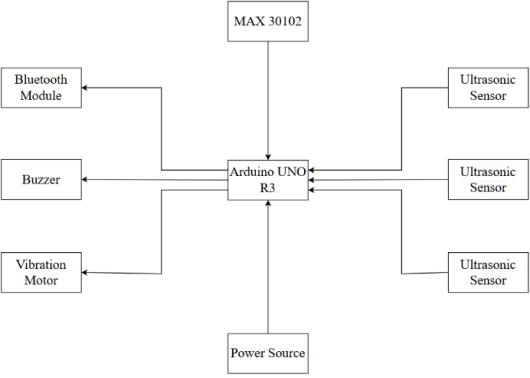



 Share This Article
 Twitter
 Linked In
 Facebook